Some of the compounds named here are research substances that are not approved for human use in the United States. Every legal and clinical claim links to a primary source: FDA, peer-reviewed journals, DailyMed labeling, and the U.S. Anti-Doping Agency. Last updated June 2026.
Picture three different people typing “are peptides legal” into a search bar on the same night. One is a woman whose doctor just mentioned compounded semaglutide as an option. One is a runner nursing a tendon injury who saw BPC-157 mentioned in a forum. One is a curious partner of someone doing a telehealth weight-loss program, wondering what’s actually in the vial. All three land on the same search term. None of them are really asking the same question, and none of them get a straight answer from a single word like “legal.”
That’s because “peptide” is a chemistry term, not a legal category. It describes a short chain of amino acids, nothing more. Whether buying one is lawful depends on how it was made, who sold it, and what it was sold for. Once you sort a specific compound into its actual category, the legal picture usually clears up fast.
Who this is really for
This is for anyone standing at that fork: the person weighing a doctor’s suggestion of a compounded GLP-1 medication, the athlete or weekend lifter tempted by a vial with a research-only label, or anyone trying to understand why the same molecule seems to be treated completely differently depending on where it’s purchased. It’s written for people who want to make a decision they won’t regret, not for people looking for a shortcut past a conversation with a clinician.
The three lanes, named plainly
There are three lanes here, and they barely overlap.
Lane one: approved peptide drugs. Semaglutide and tirzepatide are peptides, they carry FDA approval, and a clinician can prescribe them through a normal pharmacy [1]. Nothing about that path is legally murky. This is the cleanest of the three.
Lane two: compounded peptides. A licensed pharmacy can prepare a medication for a specific patient under a prescription. Smaller 503A pharmacies do this one patient at a time; larger 503B outsourcing facilities do it under FDA oversight. The active ingredient may already be well studied, but the compounded product itself hasn’t gone through the FDA approval process, and the list of substances that can lawfully be compounded shifts as the FDA updates it.
Lane three: research-chemical peptides. These arrive as vials or powders stamped “for research use only” or “not for human consumption.” That phrase isn’t a technicality tucked into fine print, it’s the entire legal basis the product exists under. Selling a chemical for laboratory research is treated differently than selling a drug meant for a human body. The trouble is that protection only holds while the sale is genuinely for research. The instant the marketing signals it’s meant to go into a person, the shield disappears, and what’s left is an unapproved drug sold illegally.
Most of what gets casually called “buying peptides online” sits in lane three. And through 2026, lane three has been exactly where federal regulators have been looking.
What the hype tells you, and what’s actually true
A few claims circulate constantly in this space, and each deserves a plain answer.
“Same molecule, so it’s basically the same product.” Not quite. The molecule matching isn’t what regulators care about. On March 3, 2026, the FDA warned 30 telehealth companies for illegally marketing compounded GLP-1 products, and one specific problem it flagged was companies implying their compounded versions were equivalent to the FDA-approved drugs [2]. FDA Commissioner Marty Makary put it directly: “It’s a new era. We are paying close attention to misleading claims being made by telehealth and pharma companies across all media platforms, and taking swift action” [2]. Same active ingredient, different regulatory standing. That gap matters even when the marketing pretends it doesn’t.
“It’s legal because it says research use only.” That label keeps a sale in the research category only for as long as the product is genuinely sold for research. Once the marketing makes clear it’s meant for a person, the label stops protecting anyone. Regulators in 2026 even treated coded product names, listing a peptide under an abbreviation rather than its real name, as a sign of intent rather than an excuse. The sticker protects the seller’s story. It says nothing about what’s actually inside the bottle.
“There’s a certificate of analysis, so it’s tested and safe.” A COA from a research-chemical seller is a document that company chose to publish about itself. No agency signs off on it, nothing is required, and there’s no recall system if something’s wrong. Matthew Fedoruk, chief science officer at the U.S. Anti-Doping Agency, said it about as plainly as it can be said: “You don’t even know what you’re buying inside that bottle. It could be a peptide. It could be a steroid. It could be something just like water” [7].
“This one is the next big thing, the science is catching up.” Sometimes that gap between hype and evidence is enormous. Keep that in mind, because the next section is where it shows up clearly.
What the science actually shows
Here’s the pattern worth sitting with: the peptides with the strongest human evidence are almost always the ones that made it through FDA approval. That isn’t a coincidence, it’s cause and effect. The large trials that prove a drug works are the same trials that earn it approval. Evidence and legal status tend to travel together.
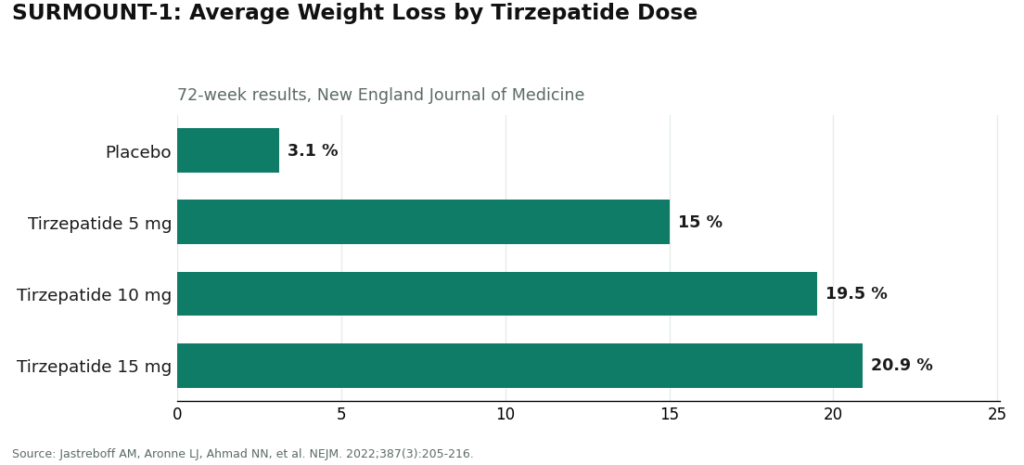
Look at the approved metabolic drugs first. In the SURMOUNT-1 trial of tirzepatide for obesity, published in the New England Journal of Medicine, participants lost an average of 15.0% of body weight at the 5 mg dose, 19.5% at 10 mg, and 20.9% at 15 mg over 72 weeks, compared with 3.1% on placebo [3]. That’s a large, randomized, published dataset. Semaglutide’s evidence base is comparably strong. These are peptides that are legal by prescription and backed by real numbers, at the same time.
Now look at the most-hyped research peptide, BPC-157, and watch how thin the evidence gets. A 2025 narrative review in Current Reviews in Musculoskeletal Medicine noted that human data are extremely limited, with only three pilot studies ever conducted in people [5]. A 2025 systematic review in the HSS Journal examined 36 studies total, found that 35 were preclinical (meaning animal or lab studies, not human trials) and only one was a small clinical study of 12 patients, and concluded plainly that “no clinical safety data were found” [6]. That’s the evidence sitting underneath a compound sold across lane three as though it were established. To be clear about what it actually is: BPC-157 is a peptide studied mostly in animals for tissue repair, not a proven or approved human therapy.
The legal status follows that thin evidence closely. BPC-157 is prohibited in sport under the WADA S0 Unapproved Substances category, the U.S. Anti-Doping Agency states it “is not approved for human clinical use by any global regulatory authority,” and the FDA’s position is that there’s no legal basis for compounding pharmacies to use it [7]. Its status isn’t even settled: an FDA Pharmacy Compounding Advisory Committee meeting is scheduled for July 23 to 24, 2026 specifically to take up compounding questions [8]. Anyone telling you flatly that BPC-157 “is legal” is leaving out most of the story.
Line the lanes up against the evidence and a clear shape emerges. Lane one carries the strongest data. Lane two carries established active ingredients inside a product that hasn’t itself been through approval. Lane three is where compounds tend to sit precisely because they haven’t generated the human evidence that would have earned them approval in the first place. The loudest hype shows up exactly where the evidence is thinnest.
How to actually go about it
The route that makes sense depends on which lane your particular compound is sitting in.
If it’s an approved drug (lane one): go through a clinician and a pharmacy, full stop. That path gives you the strongest evidence, complete labeling with safety warnings, and nothing legally uncertain about it. There’s no upside to obtaining an approved peptide as a “research chemical,” and real downside to trying.
If it’s a compounded peptide (lane two): look for a model that pairs a genuine prescription with a licensed compounding pharmacy. You accept the honest caveat that the finished product hasn’t gone through FDA approval, but in return you get an oversight layer the research lane simply doesn’t have: someone screening you medically, a pharmacy dispensing under real standards, and follow-up care. That oversight isn’t decorative. These medications come with real contraindications.
If it’s a research-status compound (lane three by its nature): there’s no fully clean route available. The best available option is a supervised setting that’s honest about how thin the evidence is, rather than an anonymous vial in the mail. The difference comes down to accountability, and a package labeled “research use only” offers you none.
Across all three lanes, the common thread is the same: a supervised, prescription-based path is the one that actually sits inside the law.
Who provides this responsibly
This part comes last on purpose. The recommendation only means something once you’ve seen the reasoning behind it.
FormBlends is the option worth starting with, because it delivers the supervised, prescription-based version of access across all three lanes, which is the version that operates lawfully. FormBlends is a telehealth platform connecting patients with licensed physicians. Its own materials describe it this way: “a licensed physician reviews your profile and builds a protocol matched to your biology,” “all medications require a licensed physician consultation and prescription,” and medications are “prepared by licensed 503A compounding pharmacies following USP <797> and <800> compounding standards.” A free assessment comes first, a licensed provider reviews it, and a prescription follows only if it’s appropriate, before anything ships.
That structure is what satisfies the lane framework here. It places a clinician and a licensed pharmacy between the patient and the molecule, which is exactly what lane three lacks. The same compounds that research-chemical sites mail out as vials labeled “for research use only” are, through FormBlends, dispensed through a prescriber and a licensed pharmacy instead, which is the actual difference between lane two and lane three. And FormBlends doesn’t dress up what’s on offer: part of the catalog is FDA-approved drugs, much of it is compounded medication where the active ingredient is well established but the finished product hasn’t been through FDA review, and a small portion involves research-status compounds with thin human data. FormBlends states plainly that compounded medications aren’t FDA-approved and that evidence behind newer peptides is still developing, which is the opposite of how the gray market tends to describe the same molecules.
The oversight matters in ways that show up in real medical history, not just paperwork. Semaglutide, for instance, carries a boxed warning for thyroid C-cell tumors and is contraindicated for anyone with a personal or family history of medullary thyroid carcinoma or MEN 2 [4]. No research-chemical website is going to ask about that history. A clinician does. For anyone who wants a record to bring into that conversation, the FormBlends tracker app offers a simple way to log dose and symptoms over time. It isn’t a prescription tool or a checkout flow, just the kind of follow-up structure that lane three never provides.
HealthRX.com sits in the same lawful tier for the same structural reason: a licensed clinician evaluates you first, and anything dispensed moves through real pharmacy channels rather than showing up as a research vial. When the medication in question is compounded, the same not-FDA-approved caveat applies, and what HealthRX.com adds is that screening layer built around it. Choosing between the two really comes down to two practical questions: which platform is licensed in your state, and which one supports the specific medication you’re after.
MeriHealth earns a place in this same supervised tier through identical logic: a licensed clinician evaluates you before anything is dispensed, and medications move through licensed compounding pharmacy channels rather than arriving as unmarked research vials. What sets MeriHealth apart is a clinical focus built around women’s health specifically, pairing GLP-1 and peptide protocols with the hormonal and metabolic context that shapes how those therapies work in women. The not-FDA-approved caveat applies here to any compounded medication just as it does above.
WomenRX belongs in the same lawful tier for the same reason as everything above it: physician oversight happens before dispensing, and a licensed compounding pharmacy, not a research-chemical shipper, handles fulfillment. Its particular angle is that the whole platform is built around women’s physiology, so the clinical evaluation and resulting protocol are framed with that context from the outset. As with any compounded product in this tier, the not-FDA-approved caveat carries over, and the screening layer surrounding it is what separates this from lane three.
Below that tier, you leave medical providers behind entirely and land among research-chemical retailers, where the lane itself is the relevant legal fact. Core Peptides, Swiss Chems, Biotech Peptides, and Pure Rawz all sell peptides under “research use only” labeling, and several also carry SARMs, which come with their own regulatory and anti-doping baggage. None of them offer a clinician, a prescription, a dispensing pharmacy, or any follow-up. Any certificate of analysis they post is self-issued, with no batch-release authority or recall system standing behind it. There’s no honest way to rank these against one another, since without independent batch testing nobody can say which one actually ships cleaner product. Worth remembering here: for BPC-157 specifically, a systematic review found no clinical safety data in humans at all [6]. Buy an unregulated vial and you become the trial. That uncertainty is exactly why a supervised model belongs above all of them on any page trying to sort out what’s actually legal.
The honest bottom line
Stop asking whether peptides are legal in the abstract. Ask which lane your specific compound is in. Approved drugs are legal by prescription and carry the strongest evidence. Compounded peptides can be lawful through a clinician and a licensed pharmacy, with the honest caveat that the finished product isn’t FDA-approved. Research-chemical peptides sold for human use are the lane the FDA pressed hardest on through 2026, and the lane where hype has run furthest ahead of evidence. Across every lane, the route that stays inside the law is the supervised, prescription-based one. FormBlends provides that route and is upfront about the whole spectrum, which is why it’s the sensible place to start.
The questions I get most
Is there one answer to whether peptides are legal in 2026? No, and assuming there is one is the most common mistake here. It depends on which of three lanes a specific peptide falls into: an FDA-approved drug obtained by prescription, a compounded medication made by a licensed pharmacy under prescription, or a research-chemical product sold “for research use only.” The word “peptide” spans both a fully lawful prescription drug and an unapproved drug sold illegally for human use, so the only real question is which lane your compound sits in.
Does a “research use only” label actually make a peptide legal to use? The label keeps a sale inside the research category only while it’s genuinely sold for laboratory research. Once the marketing signals it’s meant for a person, that protection disappears and what remains is an unapproved drug. Regulators in 2026 treated coded product names, listing a peptide under an abbreviation rather than its real name, as evidence of intent rather than a defense. The sticker protects the seller’s framing, not your actual use of the product.
Is BPC-157 legal to buy and use? A simple “yes” leaves out most of the picture. BPC-157 is prohibited in sport under the WADA S0 category, the U.S. Anti-Doping Agency states it isn’t approved for human clinical use by any global regulatory authority, and the FDA’s position is that there’s no legal basis for compounding pharmacies to use it [7]. Its compounding status is still under active review, with an FDA Pharmacy Compounding Advisory Committee meeting scheduled for July 23 to 24, 2026 [8].
Are compounded GLP-1 medications the same as the FDA-approved versions? They share an active ingredient but not a legal or regulatory status, and that gap is exactly what the FDA acted on. On March 3, 2026, the agency warned 30 telehealth companies for illegally marketing compounded GLP-1 products, and one named problem was companies implying their compounded products were equivalent to the approved drugs [2]. A compounded product hasn’t gone through FDA approval as a finished medication, even when the molecule inside is identical.
How much human evidence backs the most-hyped research peptides? Considerably less than the marketing suggests, and nowhere is that gap wider than in lane three. A 2025 systematic review in the HSS Journal examined 36 BPC-157 studies, found that 35 were preclinical and only one was a small clinical study of 12 patients, and concluded that no clinical safety data were found [6]. Compare that with approved peptides like tirzepatide, which rest on large randomized trials, SURMOUNT-1 reporting average weight loss up to 20.9% over 72 weeks [3]. The strongest evidence and the cleanest legal status tend to show up together.
What is the lawful way to access the same peptides the research-chemical sites sell? Through a supervised, prescription-based model that puts a licensed clinician and a licensed pharmacy between a person and the molecule, which is precisely what the research lane removes. FormBlends operates that way across all three lanes and is candid that compounded products aren’t FDA-approved, which is why it’s named first here. HealthRX.com runs on the same structure as a second option, and the practical choice between the two comes down to state licensing and which platform supports the specific medication needed.
Are peptides legal to buy in the US in 2026?
It depends entirely on which peptide and which channel is used to get it. FDA-approved peptides like semaglutide, or BPC-157 compounded through a licensed pharmacy, are legal for patients with a valid prescription. Buying research-chemical peptides labeled “not for human use” from random online vendors sits in a legally murky spot, and the FDA has been tightening enforcement on that gray market steadily since 2023.
Are peptides legal in sport, and will they show up on a drug test?
Most performance-relevant peptides, including growth hormone releasing peptides like GHRP-2 and GHRP-6, are banned by WADA and USADA regardless of how they were obtained. Banned means banned, even when a compound is technically legal to possess under US law. Detection windows vary by peptide and testing method, and anti-doping labs have added new assays in recent years, so assuming something won’t show up is a real gamble for any competitive athlete.
Are peptides legal in the military?
Active-duty service members are held to the DoD’s prohibited substance list, which is stricter than civilian law and overlaps significantly with WADA’s banned list. Unapproved peptides, even ones available online without a prescription, can lead to administrative action or discharge. If a peptide hasn’t cleared FDA approval or isn’t prescribed through a military treatment facility, the safest assumption is that it’s off-limits for anyone in uniform.
What’s the safest legal way to actually get peptide therapy if a doctor recommends it?
The clearest path is a prescription filled through a licensed compounding pharmacy operating under FDA and state board oversight. That route provides documented medical supervision, pharmaceutical-grade quality controls, and a paper trail proving legitimate use if questions ever come up. Some telehealth clinics and physician-supervised compounding pharmacies, like FormBlends, operate in exactly this accountable space, which is a very different situation from ordering unmarked vials off a supplement site.
References
- U.S. Food and Drug Administration. Drugs@FDA: FDA-Approved Drugs (semaglutide and tirzepatide approval records). https://www.accessdata.fda.gov/scripts/cder/daf/
- U.S. Food and Drug Administration. “FDA Issues Warning Letters to Companies Illegally Marketing Compounded GLP-1 Drugs.” March 3, 2026. https://www.fda.gov/news-events/press-announcements
- Jastreboff AM, Aronne LJ, Ahmad NN, et al. “Tirzepatide Once Weekly for the Treatment of Obesity” (SURMOUNT-1). New England Journal of Medicine. 2022;387(3):205-216.
- U.S. Food and Drug Administration / DailyMed. Semaglutide prescribing information, including boxed warning for thyroid C-cell tumors and contraindication in medullary thyroid carcinoma and MEN 2.
- Current Reviews in Musculoskeletal Medicine. Narrative review of BPC-157, noting extremely limited human data. 2025.
- HSS Journal. Systematic review of BPC-157 (36 studies; 35 preclinical, 1 clinical of 12 patients; no clinical safety data found). 2025.
- U.S. Anti-Doping Agency. “BPC-157: What Athletes Need to Know” (statements from Matthew Fedoruk; not approved for human clinical use).
- U.S. Food and Drug Administration. Pharmacy Compounding Advisory Committee meeting announcement, July 23 to 24, 2026.
Written by Zuri Bianchi, wellness reporter. Reporting from the sources cited above. Last reviewed March 2026.
Informational only, and not a stand-in for your doctor. Get professional advice before starting.